
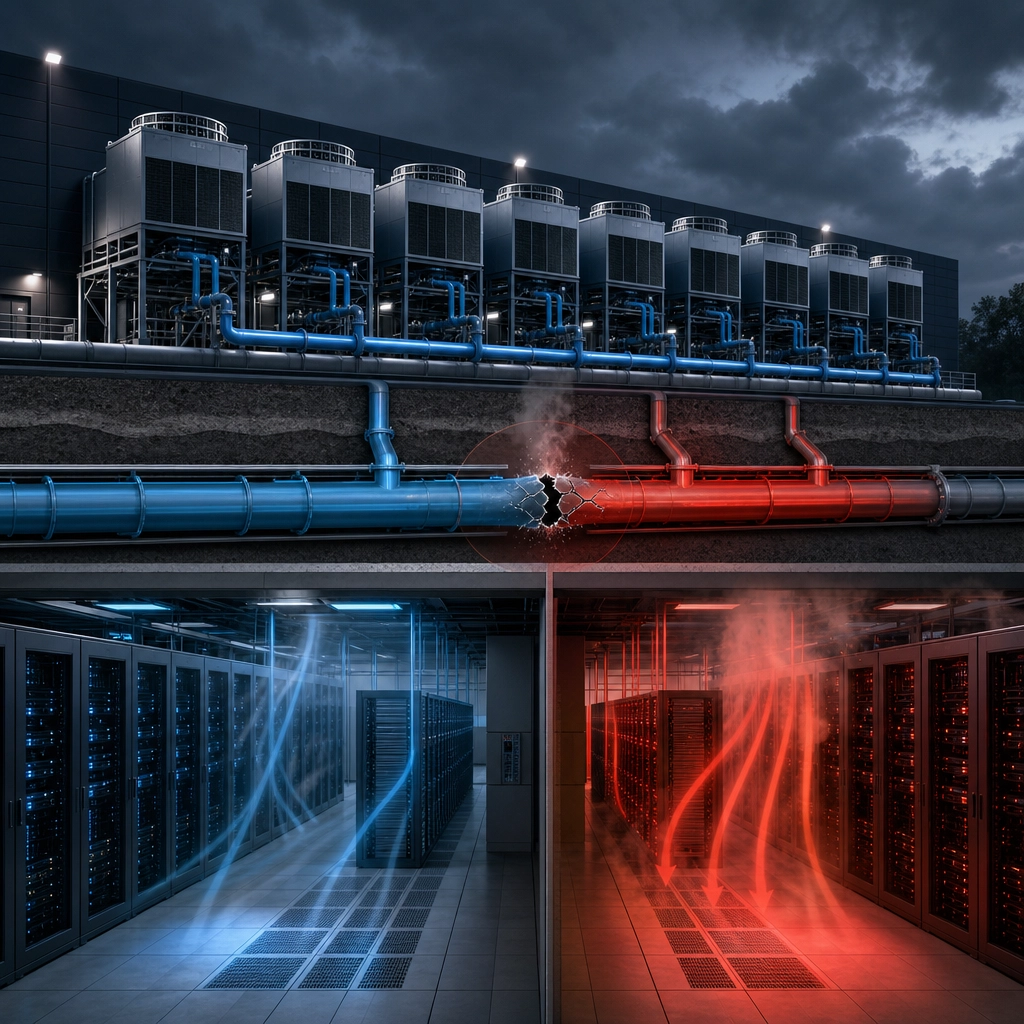
Data centers face a significant challenge in managing heat produced by continuous electrical power conversion. Effective cooling is crucial to ensure reliable operations. While many facilities appear resilient on paper with redundant components such as pumps and cooling units, potential vulnerabilities exist due to shared dependencies among these systems. These dependencies can transform an N+1 design—a system designed to handle one additional unit of capacity—into a single point of failure, leading to operational risks.
Understanding Failure Domains
A failure domain refers to the segment of a system that can be compromised by a single fault. For instance, consider four pumps configured with three operating and one standby. If only one pump fails, the system maintains its operation. However, if all four pumps are controlled by a single controller and that controller fails, all pumps will be rendered inoperative. This situation illustrates how mechanically redundant systems can still be critically dependent on shared control systems.
This dependency isn’t limited to pumps. Cooling units, chillers, and controlling power supplies may also be connected through a supervisory controller, network switch, or signal. Therefore, evaluating system resilience should not focus solely on the number of units present but rather on how many units a single fault can disable.
N+1 Complexity in Operation
While N+1 may look appropriate in theoretical designs, practical implementation reveals complexity. Redundant units may still rely on a common control mechanism or power source, which could create a point of failure unseen in initial schematics. Centralized systems often balance equipment and optimize pressures but can become critical to basic operations. A breakdown in such systems could interrupt cooling entirely, making it imperative to design for scenarios where local autonomy must take precedence.
Designing for Resilience
Not every failure needs to halt operations. For cooling systems, losing supervisory control does not necessitate halting cooling processes. Incorporating local controllers can maintain essential operations even in the absence of higher-level communication. This may include adhering to predefined parameters or manual control until system recovery.
The challenge lies in balancing operational efficiency with the robustness of backup systems. The objective should be to outline shared dependencies ahead of time, identifying how the system should react during failures.
Testing for Real-world Scenarios
The commissioning phase is where the theoretical resilience of redundancy often diverges from practical performance. Standard testing often verifies whether back-up systems can activate but may not truly test shared system dependencies. Effective commissioning should simulate disconnections in supervisory networks or failure of critical signals, allowing for the confirmation that systems will respond appropriately under stress.
Ensuring Effective Redundancy
While N+1 remains a beneficial guideline, it does not comprehensively capture the resilience of cooling systems. The pivotal question becomes identifying the largest potential failure domain in the architecture and what systems will still function when shared dependencies are disrupted. This inquiry leads to further consideration of what operations can persist under such scenarios and whether this behavior has been validated through testing.
In conclusion, a thorough understanding of dependencies among cooling systems is necessary to cultivate true redundancy within data centers, ensuring that cooling measures remain functional even when critical control systems fail.
Welcome to DediRock, your trusted partner in high-performance hosting solutions. At DediRock, we specialize in providing dedicated servers, VPS hosting, and cloud services tailored to meet the unique needs of businesses and individuals alike. Our mission is to deliver reliable, scalable, and secure hosting solutions that empower our clients to achieve their digital goals. With a commitment to exceptional customer support, cutting-edge technology, and robust infrastructure, DediRock stands out as a leader in the hosting industry. Join us and experience the difference that dedicated service and unwavering reliability can make for your online presence. Launch our website.