
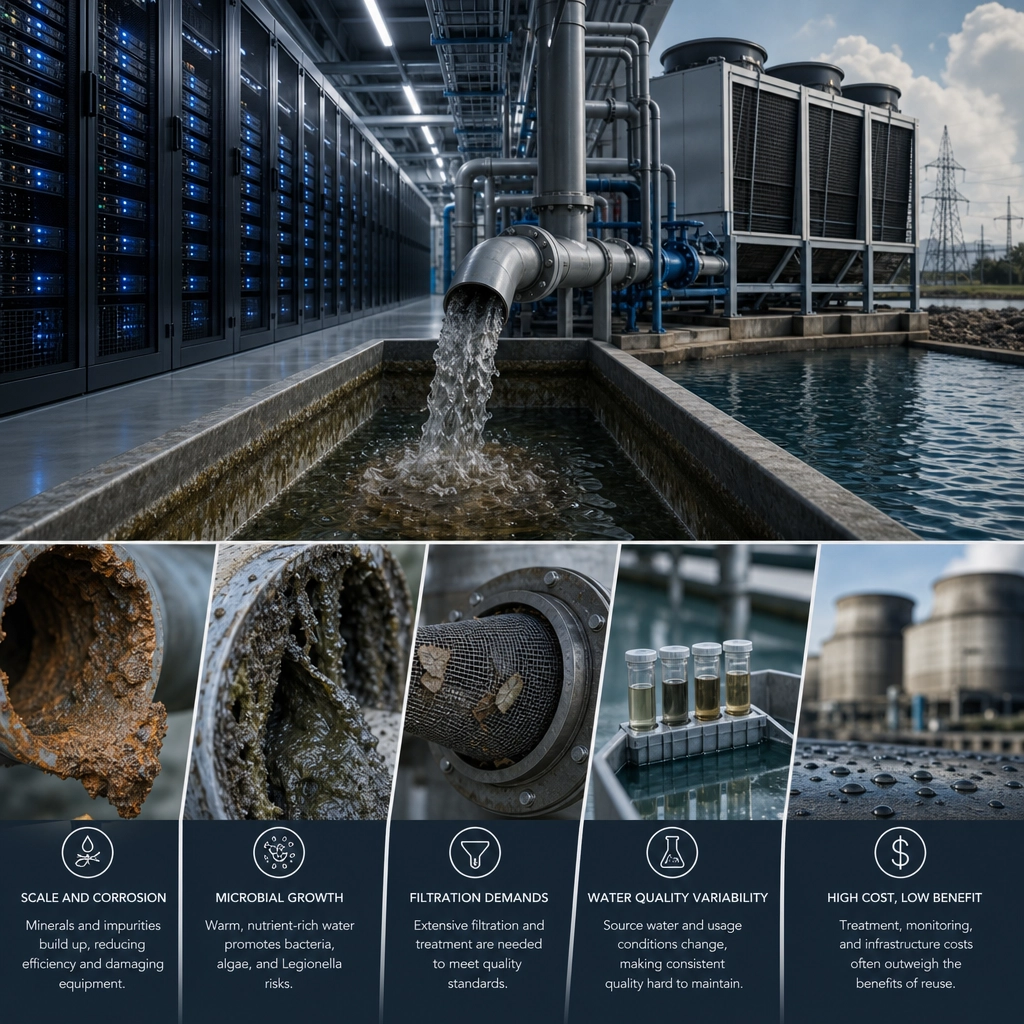
While some alternatives exist for cooling systems, many data centers continue to rely on traditional approaches primarily due to economic and operational factors. Evaporative cooling remains a prevalent method, but raises concern regarding local water supply consumption.
Data centers have a significant water footprint; a facility with 100 MW of power can use around 2.5 billion liters of water annually, equating to the water use of approximately 5,000 homes. This consumption prompts discussions on whether data centers could reduce their water intake by implementing water reuse strategies.
Understanding the Use of Water in Data Centers
Water is primarily utilized in data centers for rejecting heat produced by servers and their supporting systems. The majority of cooling relies on direct evaporative cooling, which is effective and cost-efficient. In this method, air is drawn over wetted pads, where the evaporation of water effectively removes heat.
Challenges of Water Reuse
The nature of evaporative cooling poses challenges for on-site water reuse. Most of the water used is released as vapor, making it difficult to recapture for reuse. Approximately 20% to 30% of water remains in the system after evaporation, often leading to the buildup of dissolved minerals. This scaling can clog the system and significantly reduce efficiency, necessitating regular flushing of the water, which is then treated as wastewater.
Strategies for Reducing Water Demand
Despite the current norm against water reuse, several strategies can be implemented to lessen water dependency or facilitate its reuse:
1. Closed-Loop or Hybrid Cooling Systems
Adopting closed-loop systems can allow for greater water reuse, as they recirculate fluids through piping and heat exchangers, minimizing losses. While effective, these systems can involve higher initial costs and energy requirements.
2. Treating and Reusing Blowdown Water
Operators can upgrade their facilities to treat and reuse water that is expelled during cooling processes. Advanced treatment methods can remove harmful minerals from water, but implementing these technologies can add to operational complexity and costs.
3. Repurposing Residual Water as Graywater
Residual water, once treated, can be redirected for uses such as irrigation and toilet flushing. However, successful implementation hinges on local regulations and the need for ongoing demand for such water.
Future Directions for Water Reuse in Data Centers
Currently, the economics of reusing water do not favor widespread adoption, particularly as treating water adds complexity and cost. However, rising water prices and regulatory pressures might drive more facilities to explore water reuse options. As circumstances change, there’s potential for more data centers to begin recycling water, moving away from traditional practices by leveraging advances in technology and regulatory frameworks. For the time being, most water used in evaporative cooling systems escapes as vapor, re-entering the natural water cycle through precipitation.
Welcome to DediRock, your trusted partner in high-performance hosting solutions. At DediRock, we specialize in providing dedicated servers, VPS hosting, and cloud services tailored to meet the unique needs of businesses and individuals alike. Our mission is to deliver reliable, scalable, and secure hosting solutions that empower our clients to achieve their digital goals. With a commitment to exceptional customer support, cutting-edge technology, and robust infrastructure, DediRock stands out as a leader in the hosting industry. Join us and experience the difference that dedicated service and unwavering reliability can make for your online presence. Launch our website.