
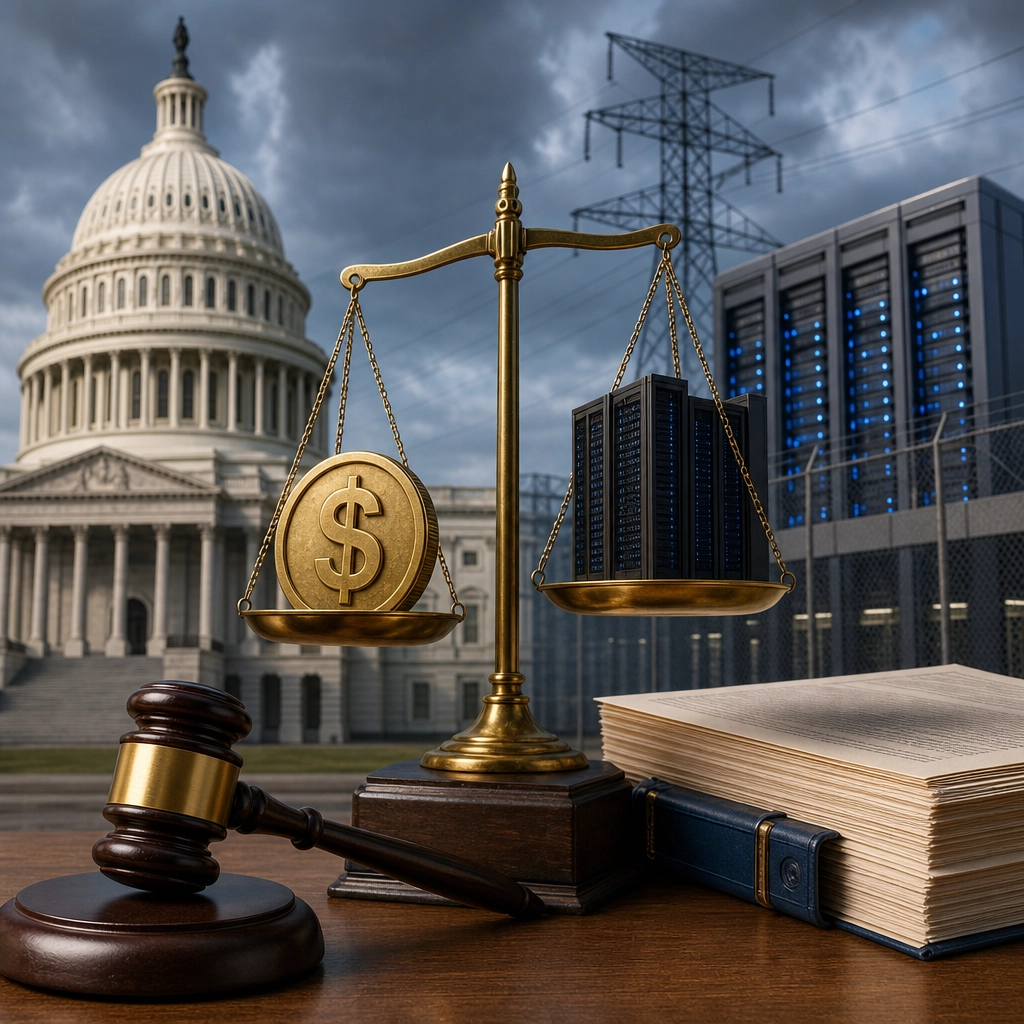
A proposed federal bill known as the Data Center Community Reinvestment Act of 2026 is poised to implement a 1-cent-per-kilowatt-hour excise tax on electricity consumed by data centers. This initiative, introduced by Rep. Andrea Salinas from Oregon, is aimed at data centers with a power capacity exceeding 1 megawatt. The revenue generated from the tax is estimated to be about $1.76 billion annually and is intended to support various federal funds, including housing and conservation initiatives.
As demand for electricity surges—driven by expanding AI and cloud computing workloads—there’s a growing concern over who should bear the costs of infrastructure and community impacts associated with data center growth. In introducing the bill, Salinas emphasized the importance of ensuring that communities benefit from data center growth rather than solely enduring its costs. She articulated that every community deserves to negotiate fairly with data center developers and that the benefits of such growth should be shared.
The bill builds on a recent state-level initiative in Virginia, which imposed a similar tax on data center electricity consumption. Virginia started taxing data center power at a rate of 1.1 cents per kilowatt-hour in July, aiming to generate approximately $600 million annually for its general fund.
Under the federal proposal, a large data center could incur significant tax liabilities. For instance, at full power load, a 100-megawatt facility would face an annual tax of around $8.76 million; at 500 megawatts, it’s about $43.8 million; and for 1 gigawatt, it would reach around $87.6 million. Assuming a typical operational load of 90%, these figures would be slightly lower. Industry experts suggest that while this tax could affect decisions regarding the location and power procurement of data centers, factors such as access to power and infrastructure may be of greater importance for large AI and hyperscale projects.
Critics, however, argue that the bill’s flat tax approach does not take into account the varying costs that different facilities impose on the energy grid. The proposed tax doesn’t differentiate between facilities based on how they affect the grid, their load characteristics, or their specific location.
Salinas’ bill stipulates that the tax revenue will be divided equally among five federal funds—supporting land and water conservation, housing initiatives, hazardous waste management, highway infrastructure, and energy technology projects.
Overall, while this legislation aims to generate funds to benefit communities impacted by the rapid growth of data centers, it raises questions regarding the appropriate distribution of costs and accountability related to expanding electricity demands linked with digital infrastructure. The proposal is currently under consideration in Congress and has been referred to several committees for further discussion and analysis.
Welcome to DediRock, your trusted partner in high-performance hosting solutions. At DediRock, we specialize in providing dedicated servers, VPS hosting, and cloud services tailored to meet the unique needs of businesses and individuals alike. Our mission is to deliver reliable, scalable, and secure hosting solutions that empower our clients to achieve their digital goals. With a commitment to exceptional customer support, cutting-edge technology, and robust infrastructure, DediRock stands out as a leader in the hosting industry. Join us and experience the difference that dedicated service and unwavering reliability can make for your online presence. Launch our website.