
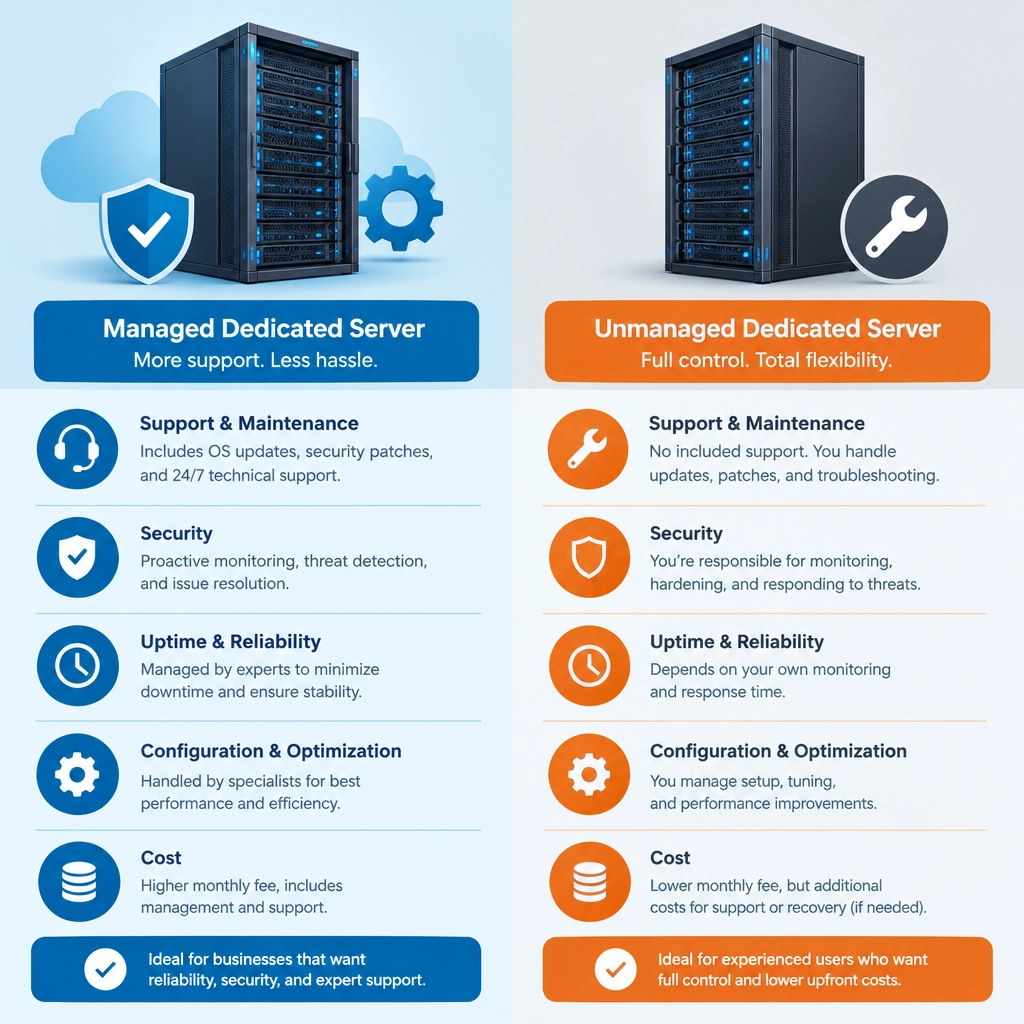
Managed vs. Unmanaged Dedicated Servers: A Practical Comparison
A dedicated server gives your website or application its own physical machine, rather than sharing resources with other customers. That can mean more control, predictable performance, and room to handle demanding workloads. But before choosing a server, there’s another decision to make: should the hosting provider manage it for you, or should you take the reins yourself?
The right answer depends less on which option is “better” and more on your team’s skills, priorities, and appetite for hands-on work.
What does “managed” actually mean?
With a managed dedicated server, the hosting provider takes care of some or much of the server’s day-to-day operation. Services vary, but may include operating system updates, security monitoring, backups, server setup, troubleshooting, and technical support.
The provider might manage only the underlying hardware and network—or handle much of the software stack too. So don’t assume every “managed” plan includes the same services. Check exactly what’s covered, how often backups run, and whether support is available around the clock.
An unmanaged dedicated server usually means the provider supplies the hardware, power, network connection, and data center. You—or your team—are responsible for installing and maintaining the operating system, applying updates, configuring security, monitoring performance, and resolving most software issues.
In short: managed hosting buys you more support; unmanaged hosting gives you more responsibility and control.
The practical differences
Time and technical expertise
Managed hosting is often a good fit for businesses without a dedicated systems administrator. If a server problem appears at 2 a.m., having a provider responsible for support and maintenance can be a major relief. Your team can spend more time on the product, customers, or content instead of server upkeep.
Unmanaged servers make sense when you already have people who know how to administer servers—or when the workload is simple enough that you’re comfortable learning. The trade-off is that maintenance doesn’t disappear. Updates, monitoring, and incident response still need an owner.
Control and customization
Unmanaged hosting generally offers greater freedom to choose your software, configure the operating system, and adjust the environment to suit specific needs. That flexibility can matter for specialized applications, custom security policies, or unusual configurations.
Managed plans may also allow customization, but the provider’s support policies can set limits. Some providers won’t troubleshoot software they don’t support, for example. Ask before committing if your setup depends on particular tools or configurations.
Cost beyond the monthly price
Unmanaged servers often have a lower monthly fee. But the server price is only part of the cost. You may also need to account for staff time, security tools, backup storage, monitoring services, and the cost of fixing mistakes or downtime.
Managed hosting usually costs more upfront, but the added support may be worthwhile if it replaces outside consultants or frees up valuable staff time. Compare the total cost of operating each option—not just the advertised hosting price.
Security and reliability
Neither option is automatically secure. With managed hosting, the provider may handle updates and monitoring, but you still need to understand which security tasks are included and which remain your responsibility. For example, application-level security and account permissions may still fall to your team.
With unmanaged hosting, you have direct responsibility for keeping the server patched, monitoring for suspicious activity, and maintaining reliable backups. That can be an advantage if you need precise control, but only if someone has the time and expertise to do the work consistently.
Which option is right for you?
Choose managed hosting if you want support with routine server operations, have limited in-house expertise, or would rather focus on running your business than maintaining infrastructure. It can also be a practical choice for businesses where downtime would be costly and fast technical assistance matters.
Choose unmanaged hosting if you have experienced administrators, need extensive control, or are comfortable taking full responsibility for maintenance and troubleshooting. It can offer strong value when you have the skills to manage the server efficiently.
Before signing up, ask providers a few direct questions: What does the plan manage? Who installs security updates? Are backups included, and can they be restored quickly? What happens during an outage? Clear answers can prevent unpleasant surprises later.
A dedicated server is a powerful foundation, but the best hosting plan is the one your team can manage well. If you’re paying for support you don’t need, unmanaged may be a better fit. If server upkeep is distracting you from more important work, managed hosting may be worth the premium. The smartest choice is the one that matches your actual capacity—not just your preferred level of control.
Welcome to DediRock, your trusted partner in high-performance hosting solutions. At DediRock, we specialize in providing dedicated servers, VPS hosting, and cloud services tailored to meet the unique needs of businesses and individuals alike. Our mission is to deliver reliable, scalable, and secure hosting solutions that empower our clients to achieve their digital goals. With a commitment to exceptional customer support, cutting-edge technology, and robust infrastructure, DediRock stands out as a leader in the hosting industry. Join us and experience the difference that dedicated service and unwavering reliability can make for your online presence. Launch our website.