
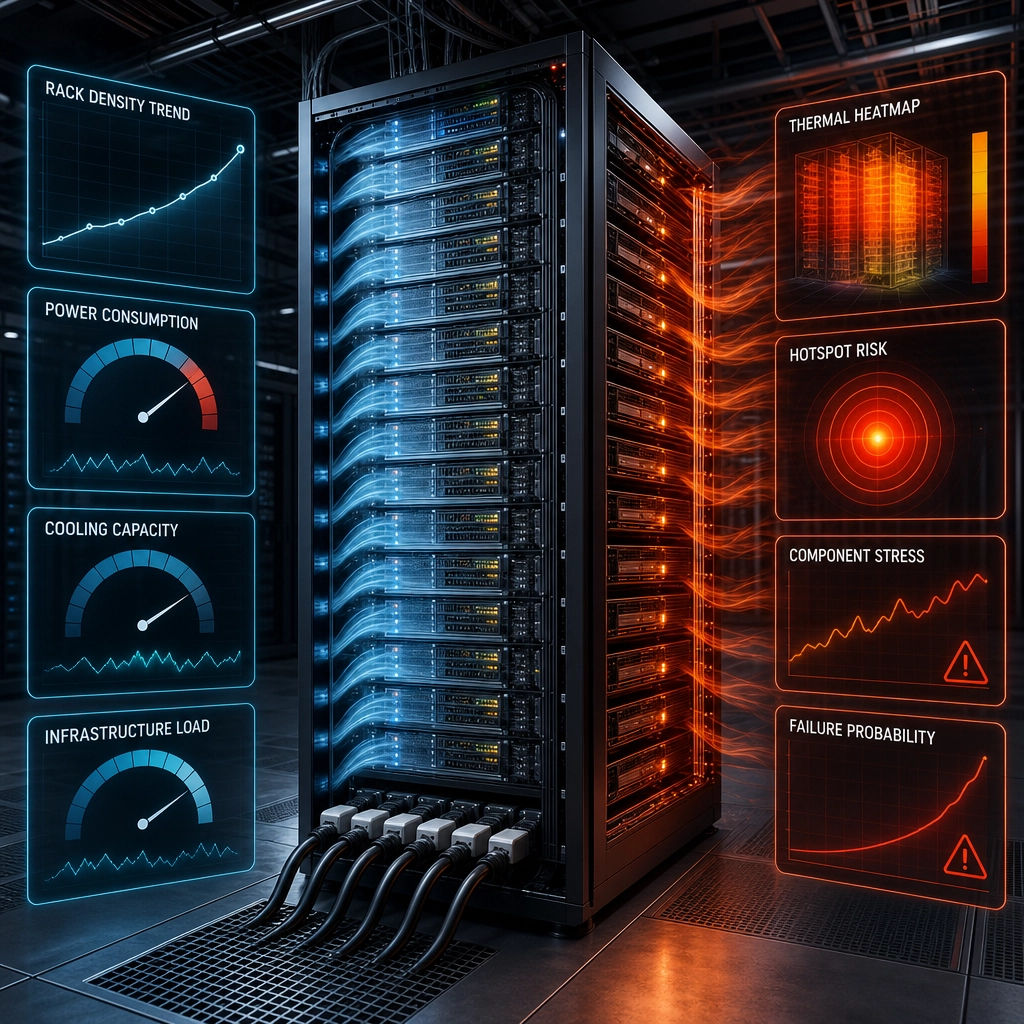
For decades, advancements in hardware have led to increasingly powerful computing capabilities being packed into smaller spaces. The rise of AI has accelerated this trend to unprecedented levels, compelling data centers to maximize performance for AI workloads.
The transformation within the industry has been significant. Just two years ago, certain rack configurations seemed overzealous, yet they have quickly become commonplace. According to the Uptime Institute’s 16th Annual Global Data Center Survey, modal rack density reached 11 kW in 2026, marking a rise from 9 kW the prior year. However, this relates to standard enterprise environments, not the demanding AI training clusters.
AI racks operate on an entirely different power scale, often requiring much more energy. For instance, Nvidia’s GB300 NVL72, pivotal for AI training, can demand upwards of 142 kW per rack. The newer Vera Rubin NVL72, which entered production in mid-2026, is anticipated to require between 190 kW and 230 kW, while the upcoming Rubin Ultra NVL576 is projected to require around 600 kW.
The real limits of rack density hinge on three primary factors: heat dissipation capabilities, the power requirements of chips, and the power that facilities can safely supply. Misconceptions abound that chip quantities or larger fans limit density, yet Joseph Wolff, founder and CTO of eRacks Systems, asserts that it is largely a matter of electrical and cooling engineering.
Cooling Solutions Evolve
With increasing compute demands, heat management becomes increasingly crucial. Traditional air cooling is feasible only up to approximately 50 kW per rack; beyond that, airflow struggles to handle the heat generated. Currently, liquid cooling—which has a market share of 55%—is becoming the standard, as it can manage up to 150 kW by supplying liquid coolant directly to cold plates installed on chips.
Despite trials, technology innovations like two-phase immersion cooling have faced setbacks, particularly due to regulatory challenges regarding coolant supplies. Moreover, newer methods, like microfluidics directly integrated into chips, show promise for enhanced heat dissipation.
Power Delivery Challenges
In addition to heat management, power supply presents its challenges. Uptime Institute notes that traditional power distribution, particularly legacy 54 VDC systems, struggle beyond 200 kW due to constraints related to copper wiring thickness. Additionally, redundancy requirements further complicate the power architecture, as typical power distribution units can only support limited loads.
The demand for higher rack densities demands innovative solutions. Systems designed for 800 VDC are paving the way, with companies like Nvidia and Vertiv already implementing them. By decoupling power delivery from compute requirements, facilities could better meet substantial power demands.
Furthermore, on-site power generation is rising in popularity as data centers look to sidestep dependencies on grid power, aligning cooling and power delivery in response to density demands.
A Look Into the Future
The future trajectory suggests that power availability will dictate the capabilities of data centers. The nature of grid limitations and the increasing prevalence of high-density racks will shape strategies in the years to come. Experts are projecting that by 2028, racks are likely to exceed 100 kW, with state-of-the-art AI deployments potentially making use of liquid cooling and advanced power delivery techniques.
Nevertheless, while high-density AI racks may dominate leading-edge applications, typical enterprise sectors are expected to adopt more conservative cooling methodologies, predominantly relying on air-cooled solutions.
As the industry grapples with evolving requirements, understanding and adapting to the limitations of heat management, power delivery, and potential failure scenarios will be pivotal to shaping future data center strategies.
Welcome to DediRock, your trusted partner in high-performance hosting solutions. At DediRock, we specialize in providing dedicated servers, VPS hosting, and cloud services tailored to meet the unique needs of businesses and individuals alike. Our mission is to deliver reliable, scalable, and secure hosting solutions that empower our clients to achieve their digital goals. With a commitment to exceptional customer support, cutting-edge technology, and robust infrastructure, DediRock stands out as a leader in the hosting industry. Join us and experience the difference that dedicated service and unwavering reliability can make for your online presence. Launch our website.