
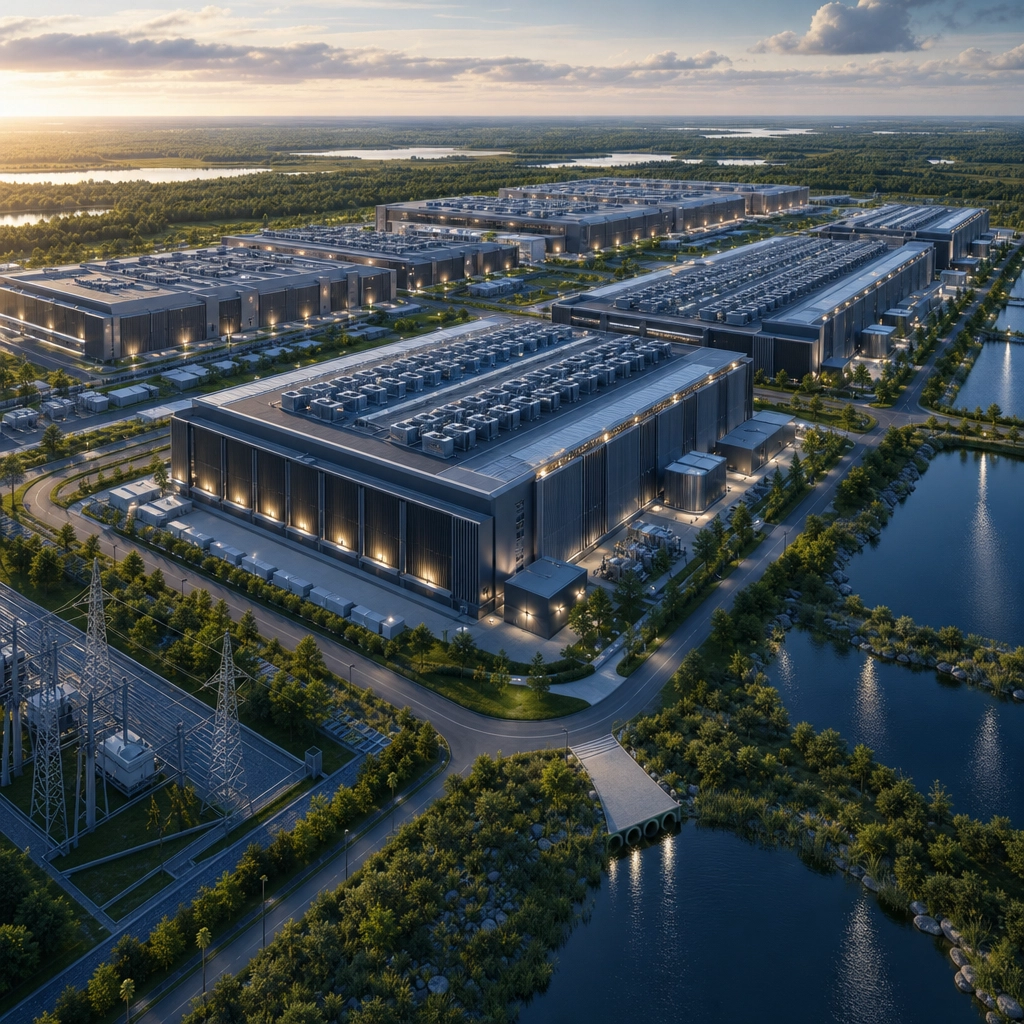
Over the past thirty years, data centers have significantly transformed from small server rooms to extensive hyperscale campuses containing hundreds of thousands of servers across multiple buildings. Facilities that once operated in square feet now span vast acres. One of the largest under construction in the U.S. is Meta’s 3,650-acre Hyperion campus in Louisiana, while ambitious projects like a 40,000-acre data center in Utah were later scaled back due to public pushback.
The expansive nature of these campuses raises the question of whether operators truly need such large spaces. According to Peter Skae, managing director of technical services at JLL, the massive scale of hyperscale data centers is driven by the high demand for cloud computing, AI, and digital services, which necessitate vast computational power and storage. Large facilities provide cost advantages through economies of scale and allow for the advanced infrastructure required for critical operations.
To manage this need, developers are increasingly opting for sites with multiple buildings instead of single large structures. This modular approach not only facilitates faster market readiness but also enhances energy efficiency and risk management while catering to multi-tenant needs. Despite this trend, there are limits to how many buildings can be constructed at once due to resource availability.
These campuses generally evolve over time and rarely operate at full capacity upon opening. The construction of these facilities often mirrors the shift toward modular chip designs, illustrating a transition from monolithic to interconnected structures.
Developers pursuing large campus sizes are motivated by changing site selection constraints. As computing workloads become more time-consuming, the need for immediate processing becomes less critical, allowing for remote site development. This shift simplifies building logistics and provides the flexibility to construct large campuses that can accommodate substantial onsite energy generation and cooling systems.
For the successful operations of these massive facilities, structured planning and management are key. Skae emphasizes the importance of using integrated technology that ensures real-time visibility and resource management across vast footprints. Effective resource planning, particularly for power and water needs, must start early in the process to address the unique requirements of each site.
The move toward larger, multi-building campuses is not merely a trend; it is a strategic response to the increasing demand for computational power and the associated economics that come with building and maintaining large-scale data centers. As the industry continues to evolve, the need for intricate planning and management in these sprawling environments will only grow, indicating that these extensive campuses are here to stay.
Welcome to DediRock, your trusted partner in high-performance hosting solutions. At DediRock, we specialize in providing dedicated servers, VPS hosting, and cloud services tailored to meet the unique needs of businesses and individuals alike. Our mission is to deliver reliable, scalable, and secure hosting solutions that empower our clients to achieve their digital goals. With a commitment to exceptional customer support, cutting-edge technology, and robust infrastructure, DediRock stands out as a leader in the hosting industry. Join us and experience the difference that dedicated service and unwavering reliability can make for your online presence. Launch our website.