
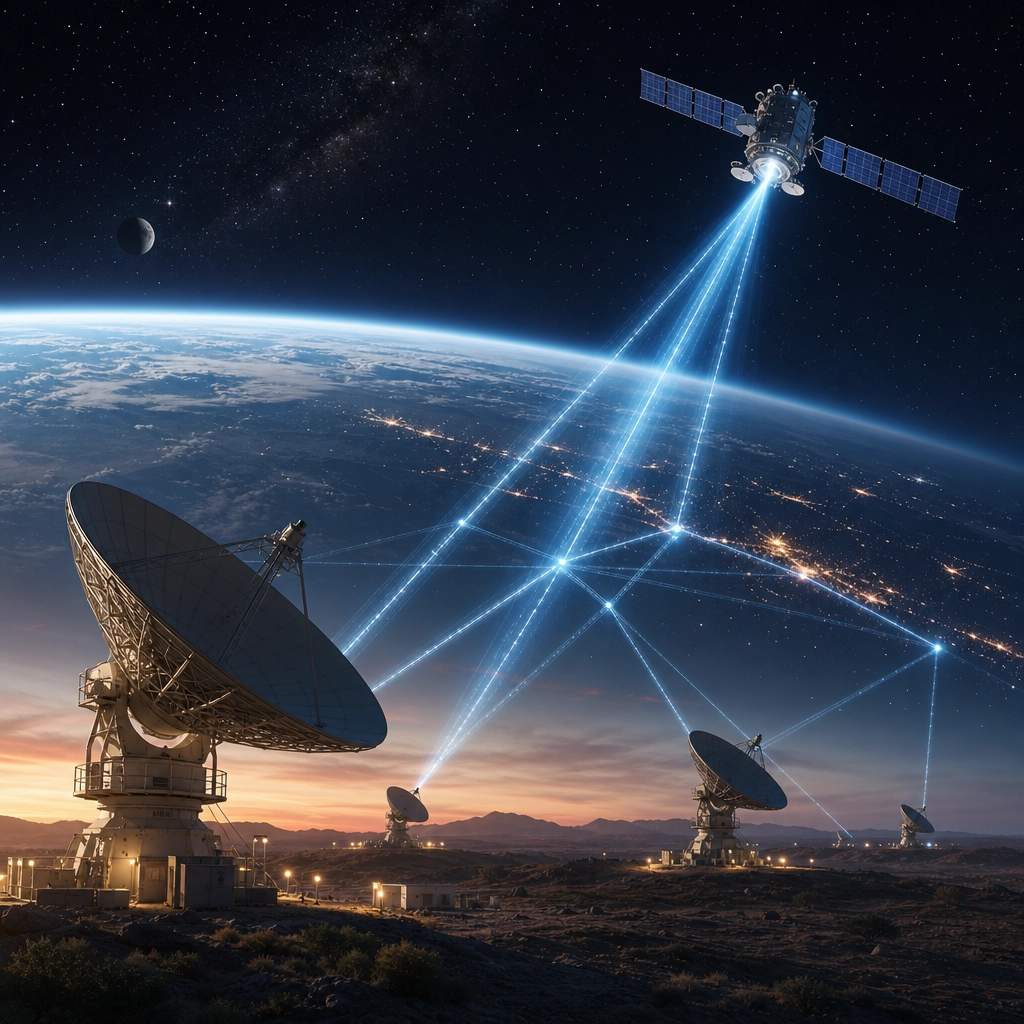
AI workloads are evolving beyond the confines of traditional data centers to span distributed terrestrial campuses, edge sites, and even low Earth orbit (LEO). This expansion requires efficient data transfer between these ground and space entities, with an increasing reliance on optical communications to overcome the limitations of conventional radio-frequency (RF) methods.
Optical, or laser, communications have the potential to significantly increase data transmission speeds. Unlike RF links, which struggle to manage large volumes of data, a single free-space optical link can handle capacities over 100 Gb/s and even reach up to 300 Gb/s. This advancement positions LEO constellations and orbital compute as integral players in supporting terrestrial AI infrastructures, ensuring they remain interconnected rather than isolated.
However, data transfer through the atmosphere presents challenges. Most signal degradation occurs within the troposphere, where factors like turbulence and cloud cover can disrupt optical signals, causing attenuation and outages that throttle the expected performance of a communication link. Current technology employs adaptive optics and diverse spatial stations to mitigate these issues, but such methods are generally reactive—they activate only after significant degradation begins.
As the demand for high-capacity space-to-ground connections increases, a proactive approach is being explored. This involves developing an atmospheric "digital twin" model that continuously updates to forecast communication performance based on real-time data. Inputs come from weather satellites, radar systems, and machine learning techniques that analyze link performance.
By anticipating atmospheric conditions, networks can manage data traffic more effectively—redirecting it to clearer stations before disruption occurs. This predictive model treats laser links as manageable resources, allowing for adaptive scheduling akin to how data centers currently plan for energy, water, and cooling needs.
The implications for AI infrastructure are crucial. As the growth of AI outpaces the capabilities of any single facility, successful integration between surface data installations and orbiting satellites hinges on reliable data transfer methods. Improving the predictability of atmospheric conditions could transform the networking landscape, making it less of a gamble and more of a calculated operational resource, thereby enhancing both terrestrial and orbital data processing capabilities.
Welcome to DediRock, your trusted partner in high-performance hosting solutions. At DediRock, we specialize in providing dedicated servers, VPS hosting, and cloud services tailored to meet the unique needs of businesses and individuals alike. Our mission is to deliver reliable, scalable, and secure hosting solutions that empower our clients to achieve their digital goals. With a commitment to exceptional customer support, cutting-edge technology, and robust infrastructure, DediRock stands out as a leader in the hosting industry. Join us and experience the difference that dedicated service and unwavering reliability can make for your online presence. Launch our website.