
What Is Bare Metal Hosting, and How Does It Compare to Dedicated Servers?
When you’re choosing infrastructure for a website, application, or data-heavy workload, two terms tend to pop up together: bare metal hosting and dedicated servers. They’re often used interchangeably, which can make the choice feel more confusing than it needs to be.
Both give you access to physical server hardware rather than sharing a machine with unrelated customers. The main difference is less about the hardware itself and more about how it’s provisioned, managed, and used.
What is bare metal hosting?
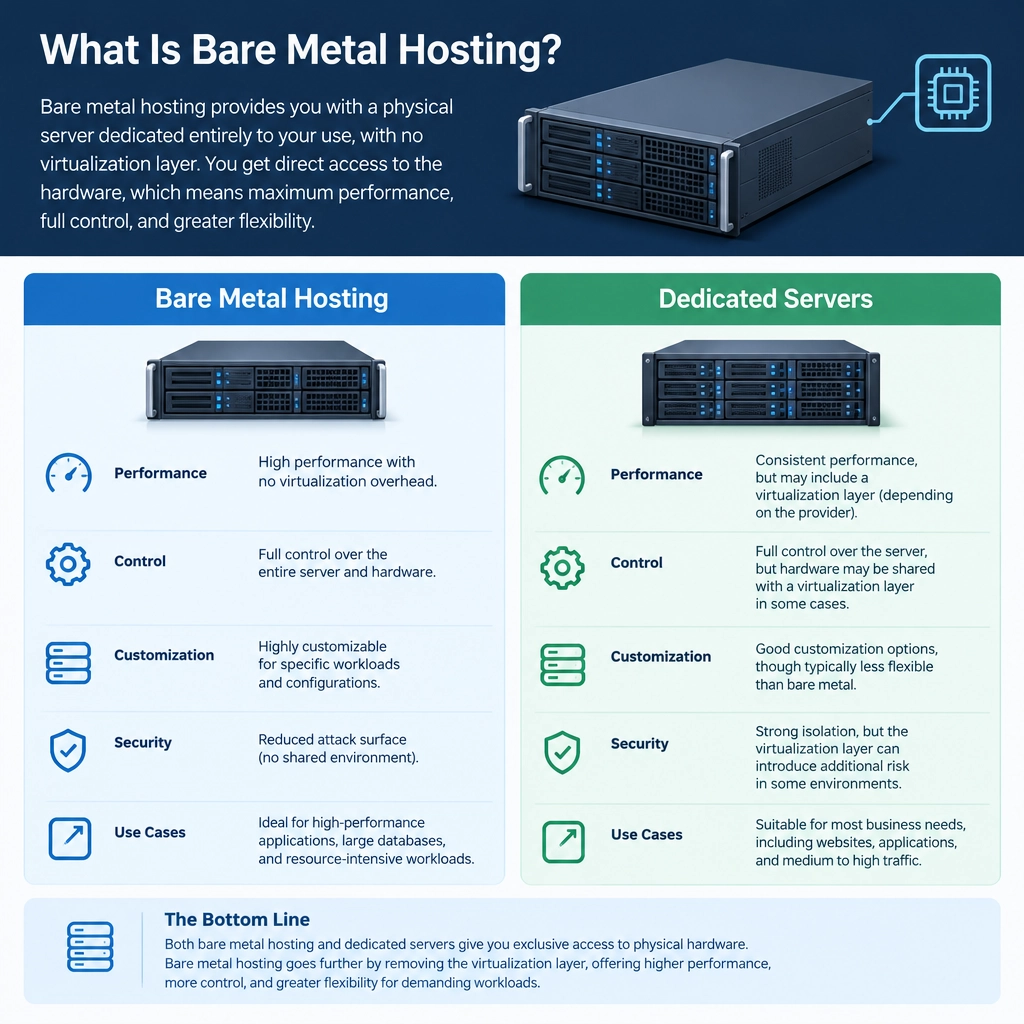
Bare metal hosting gives you a physical server reserved for your use—no hypervisor or virtual machines between your operating system and the hardware. You can typically choose the processor, memory, storage, and networking configuration, then install the operating system and software you need.
Because you’re working directly with the machine, bare metal can deliver predictable performance. You don’t have to account for the resource overhead of virtualization, and your workloads aren’t competing with other customers for the same physical CPU or memory.
That can be useful for demanding databases, high-traffic applications, real-time workloads, large-scale analytics, and software that benefits from direct hardware access. Bare metal also gives you more control over server configuration than many cloud virtual machines.
“Bare metal,” however, doesn’t automatically mean “hands-off.” Depending on the provider, you may be responsible for configuring the operating system, applying updates, monitoring the server, and handling security. Some providers offer managed bare metal, where they take on more of that work.
What is a dedicated server?
A dedicated server is also a physical machine reserved for a single customer. You get exclusive access to its hardware, which helps make performance and resource use more predictable than on shared hosting.
The term is broader, though. A dedicated server may be offered as a traditional hosting service, with the provider taking care of hardware maintenance, network connectivity, and sometimes operating-system support. It may also be configured with virtualization software, depending on the service.
In other words, “dedicated server” usually describes who gets the machine: you do. “Bare metal” more often emphasizes direct access to the physical hardware and the way the server is provisioned.
In practice, the labels can overlap. One company’s bare metal service may look much like another company’s dedicated server plan. It’s worth checking the actual specifications and management responsibilities instead of relying on the name alone.
Bare metal hosting vs. dedicated servers
| Consideration | Bare metal hosting | Dedicated server |
|---|---|---|
| Hardware access | Typically direct access to a physical server | Exclusive use of a physical server |
| Virtualization | Often deployed without a hypervisor by default | May or may not include virtualization |
| Customization | Usually offers detailed hardware and software choices | Varies by provider and plan |
| Management | Often self-managed, though managed options exist | May include more traditional hosting support |
| Performance | Consistent, with minimal virtualization overhead | Also consistent; depends on configuration |
| Scaling | May require provisioning additional machines | May require an upgrade, migration, or extra server |
The performance gap isn’t always dramatic. A well-configured virtualized dedicated server can perform very well, and many applications won’t notice a meaningful difference. Bare metal is most compelling when direct hardware access, specialized configurations, or consistently high performance are important.
Which one should you choose?
Bare metal hosting may be a better fit if you need precise hardware control, want to avoid virtualization overhead, or run workloads that put sustained pressure on a server’s resources. It can also suit teams with the technical skills to manage the operating system and server environment themselves.
A dedicated server may be a better fit if you want exclusive hardware but prefer a more conventional hosting package, especially one that includes support or management. For many websites and business applications, it offers plenty of performance without requiring you to fine-tune every layer.
Before choosing either option, ask the provider what’s included. Check whether the server is managed, how hardware failures are handled, what operating systems are supported, how quickly you can scale, and whether backups and security updates are your responsibility.
The simplest way to think about it is this: both options can give you a physical server of your own, but bare metal usually highlights direct hardware access, while dedicated server highlights exclusive use. The right choice depends less on the label and more on the workload, the level of control you need, and how much server management you want on your plate.
Welcome to DediRock, your trusted partner in high-performance hosting solutions. At DediRock, we specialize in providing dedicated servers, VPS hosting, and cloud services tailored to meet the unique needs of businesses and individuals alike. Our mission is to deliver reliable, scalable, and secure hosting solutions that empower our clients to achieve their digital goals. With a commitment to exceptional customer support, cutting-edge technology, and robust infrastructure, DediRock stands out as a leader in the hosting industry. Join us and experience the difference that dedicated service and unwavering reliability can make for your online presence. Launch our website.