
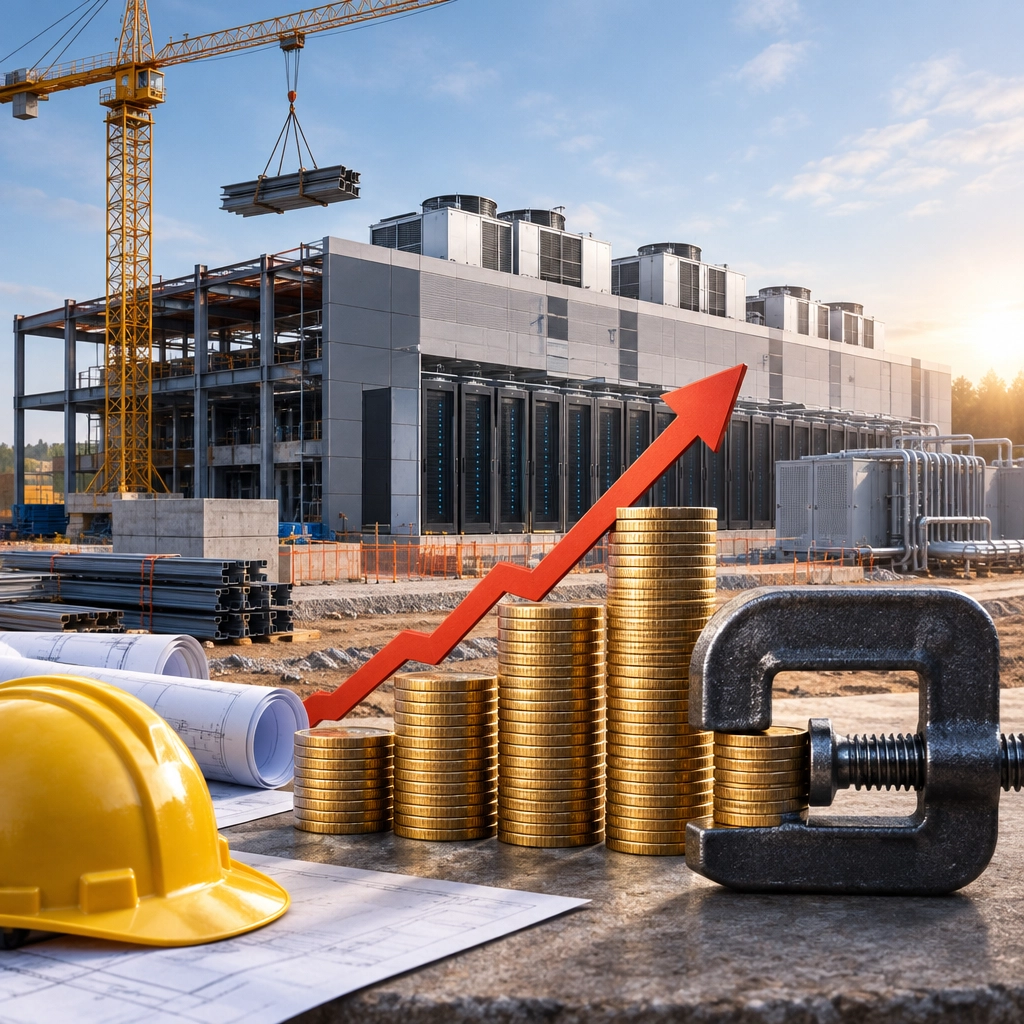
Data center developers are facing rising construction costs, and strong demand—particularly for AI infrastructure—does not guarantee that every project will remain profitable. According to JLL, developers are best positioned to absorb higher costs when they have dependable power access, committed tenants, and a realistic delivery schedule.
JLL’s 2026 Global Construction Costs Index puts annual construction cost increases at 3% to 6%, compared with 2% to 3% before 2020. The firm expects global tender prices to rise another 3.1% to 4.2% in 2027, with North American increases forecast at 3.2% to 4.2%. These projections cover construction broadly, not data centers alone.
Rising rents and property values have helped data center projects withstand some inflation. But higher asset values cannot make up for costs that outstrip contracted revenue or power delays that postpone income while financing expenses accumulate, said Matthew Giddings of JLL’s Data Centers and Critical Environments team.
The greatest risks affect speculative campuses without anchor tenants, projects with uncertain power schedules, and developments locked into fixed rents that offer little flexibility as costs climb. Older facilities being upgraded for AI workloads may also become uneconomical if the necessary improvements are too extensive.
Developers should reconsider project plans when financing costs reduce expected returns, utility timelines slip beyond planned occupancy dates, or customer demand no longer supports the proposed capacity. A drop in available power or delays in securing anchor tenants can also indicate that a project needs to be adjusted.
Phased construction can limit exposure by matching spending to confirmed power supply and customer demand. This helps avoid committing too much capital before a project’s underlying requirements are secure.
Skilled trades slow delivery
Labor shortages are adding pressure, particularly in electrical and mechanical trades. Electricians, high-voltage specialists, pipefitters, and advanced cooling technicians are among the workers in greatest demand. Controls, commissioning, and startup teams are also key bottlenecks because their availability can determine when a completed facility is ready to operate.
Competition for crews working on utilities and substations is growing, creating schedule risks beyond the data center site itself. Developers can reduce uncertainty by involving trade partners early and building schedules around actual workforce availability rather than assumed labor capacity.
Standardized designs, off-site prefabrication, and phased construction can reduce peak labor needs. In remote areas, housing, transportation, and travel incentives may help attract workers. Over time, investment in trade schools, apprenticeships, and union training facilities could strengthen the workforce and create local employment opportunities.
Secure equipment capacity while keeping designs adaptable
Long lead times for essential equipment have encouraged developers to place orders earlier. But early purchasing can be risky if tenant requirements change, especially as AI infrastructure evolves.
A balanced approach is to reserve manufacturing capacity without locking every design detail too soon. Developers can secure production slots for transformers, switchgear, generators, and cooling equipment while retaining the ability to adjust specifications before fabrication begins. Orders should progress in step with confirmed tenant needs and clearly defined decision deadlines.
This flexibility matters as operators respond to changing rack densities and growing interest in liquid cooling. Modular power and cooling systems, expansion capacity, and provisions for liquid cooling can help facilities adapt without disrupting the broader project.
Retrofitting an older facility may offer faster delivery and lower upfront costs when the site has available power, adequate structural capacity, and infrastructure that can be reused. Those benefits can fade if the building needs major mechanical upgrades, expanded electrical distribution, stronger floors, or extensive liquid-cooling work. Ultimately, the project’s viability depends on how much existing infrastructure can be retained while meeting current and future performance needs.
Welcome to DediRock, your trusted partner in high-performance hosting solutions. At DediRock, we specialize in providing dedicated servers, VPS hosting, and cloud services tailored to meet the unique needs of businesses and individuals alike. Our mission is to deliver reliable, scalable, and secure hosting solutions that empower our clients to achieve their digital goals. With a commitment to exceptional customer support, cutting-edge technology, and robust infrastructure, DediRock stands out as a leader in the hosting industry. Join us and experience the difference that dedicated service and unwavering reliability can make for your online presence. Launch our website.