
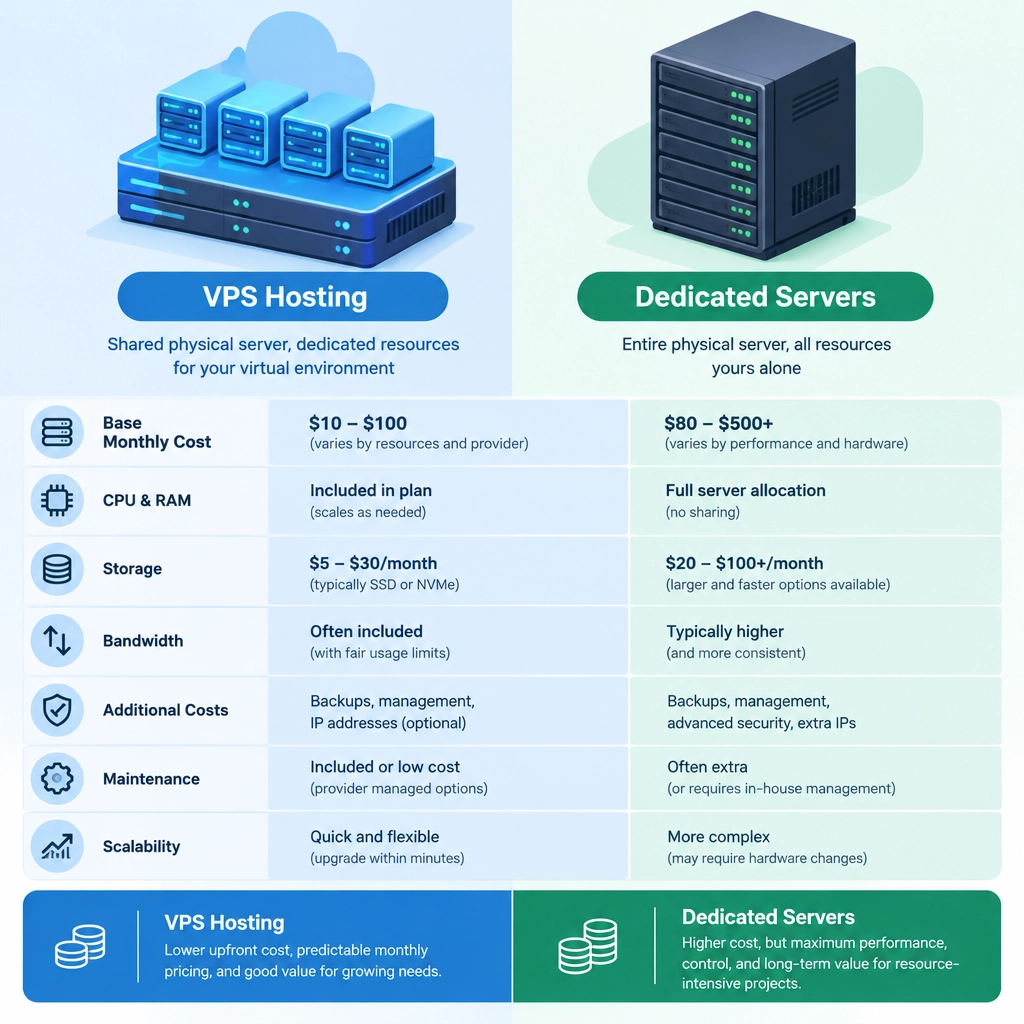
Breaking Down the Costs of VPS Hosting vs. Dedicated Servers
Choosing between VPS hosting and a dedicated server often comes down to one practical question: How much will it cost—not just today, but as your website or application grows?
VPS hosting is usually the more budget-friendly option, while dedicated servers typically offer more power and control at a higher price. But the monthly bill is only part of the story. Performance needs, management requirements, and future growth can all change which option delivers better value.
What You’re Paying For
A virtual private server (VPS) runs on a physical server shared with other customers. Virtualization software gives each customer a reserved portion of resources, such as CPU, memory, and storage. You share the underlying hardware, but your environment is separated from other users.
A dedicated server gives you an entire physical machine. You don’t share its processor, memory, or storage with other customers, which can provide more predictable performance and greater flexibility.
That difference in infrastructure is the main reason dedicated servers tend to cost more.
Typical VPS Costs
VPS plans often start at a relatively low monthly price, making them attractive for small businesses, growing websites, development projects, and applications with moderate traffic. Prices vary by provider and configuration, but generally rise with the amount of CPU, RAM, storage, and bandwidth included.
Some lower-cost plans are unmanaged. That means you’re responsible for tasks like installing software, applying updates, setting up security, and troubleshooting issues. Managed VPS plans include more hands-on support from the hosting provider, but usually cost extra.
Keep an eye out for details that may affect the final bill:
- Backups: Automatic backups may be included or charged separately.
- Storage type: Faster solid-state storage can come at a higher price.
- Bandwidth: Heavy traffic or data transfer may trigger additional fees.
- Support: Premium or managed support can increase monthly costs.
- Licenses: Control panels and certain software may require separate payments.
A low advertised price can be a good deal, but only if it includes the resources and services you actually need.
Typical Dedicated Server Costs
Dedicated servers generally have higher starting prices because you’re paying for exclusive access to physical hardware. Costs depend on the processor, memory, storage, network capacity, and whether the provider manages the server for you.
More powerful configurations—such as machines with multiple processors, large amounts of RAM, or specialized storage—can raise the price considerably. Managed dedicated hosting adds another layer of cost, but may be worthwhile if you don’t have staff available to handle server administration.
Dedicated servers can also involve expenses that aren’t obvious at first. You may need to pay for backups, monitoring, security tools, operating system or control panel licenses, and additional support. If your business requires high availability, you could also need redundant hardware or a second server, increasing the overall investment.
The Cost Beyond the Monthly Bill
The cheapest hosting plan isn’t necessarily the least expensive choice over time. A VPS may save money at first, but if limited resources cause slow load times or interruptions during traffic spikes, the business impact could outweigh the savings.
On the other hand, a dedicated server can be more powerful than you need. Paying for unused capacity means spending money without gaining meaningful benefits.
It’s also worth considering staff time. An unmanaged server may have a lower price tag, but maintaining it takes technical expertise and attention. Managed hosting costs more upfront, yet it can reduce the time your team spends on routine maintenance and help avoid preventable problems.
Which Option Offers Better Value?
A VPS is often the better fit if you’re launching a website, hosting a modest online store, running test environments, or scaling beyond shared hosting. It offers a useful balance of affordability, flexibility, and control.
A dedicated server may be worth the added cost if you handle consistently heavy traffic, run resource-intensive applications, need specialized configurations, or want to avoid sharing hardware resources. It can also make sense when predictable performance and extensive control are business priorities.
Before choosing, estimate your current resource needs and likely growth over the next year. Compare plans based on their full feature set—not just the headline price—and ask what happens if you need more capacity. The right decision is the one that gives your business enough room to perform reliably without paying for power it won’t use.
Welcome to DediRock, your trusted partner in high-performance hosting solutions. At DediRock, we specialize in providing dedicated servers, VPS hosting, and cloud services tailored to meet the unique needs of businesses and individuals alike. Our mission is to deliver reliable, scalable, and secure hosting solutions that empower our clients to achieve their digital goals. With a commitment to exceptional customer support, cutting-edge technology, and robust infrastructure, DediRock stands out as a leader in the hosting industry. Join us and experience the difference that dedicated service and unwavering reliability can make for your online presence. Launch our website.