
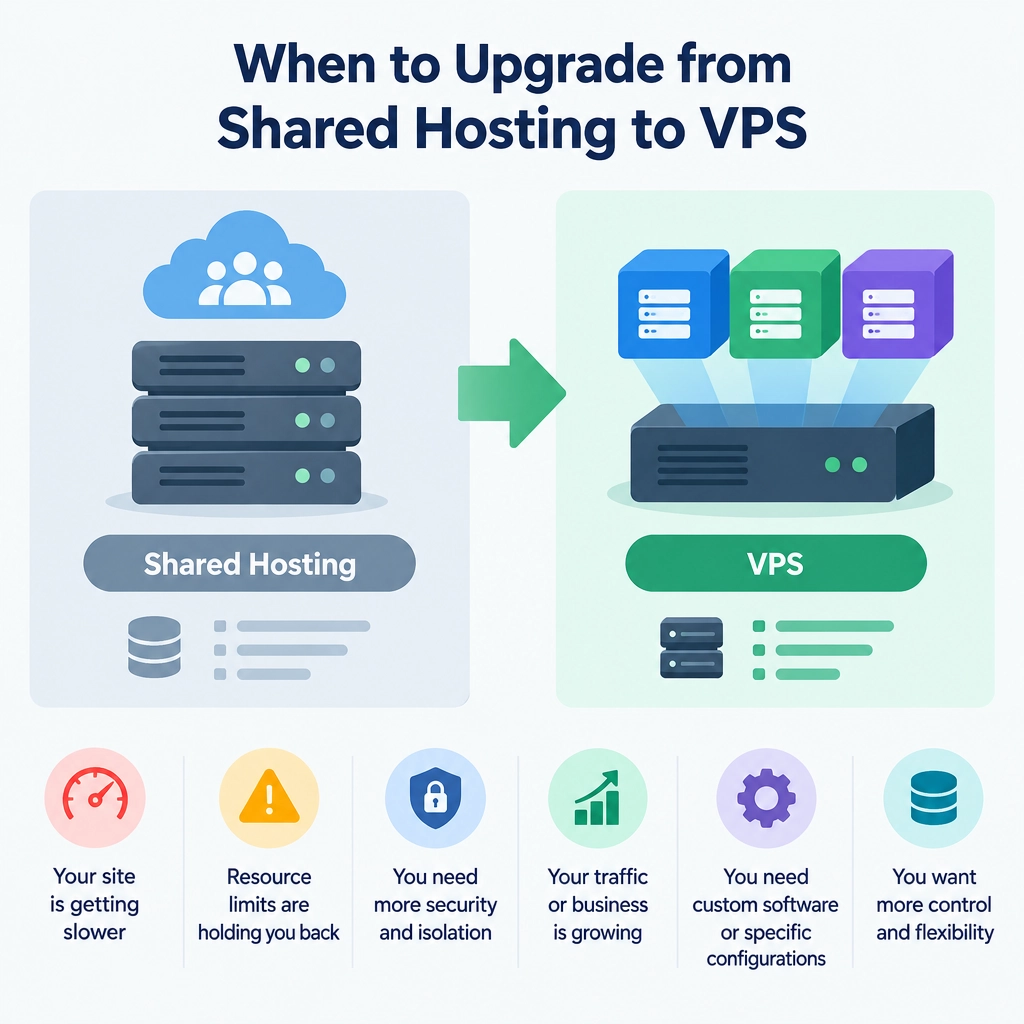
When to Upgrade from Shared Hosting to VPS
Shared hosting is a great place to start. It’s affordable, simple to manage, and often includes everything a new website needs. But as your site grows, you may start wondering whether your hosting plan is holding it back.
Moving to a virtual private server (VPS) can give you more resources, control, and room to grow—but it also comes with added cost and responsibility. The right time to upgrade depends less on how old your website is and more on what it needs.
Your site is slowing down under pressure
A few slow page loads don’t automatically mean it’s time to switch hosts. Performance can also be affected by large images, inefficient code, unoptimized databases, or too many plugins.
But if your site consistently slows down during busy periods—even after you’ve optimized it—shared hosting may be running out of steam. On a shared plan, your website uses a server alongside other customers. If server resources are stretched, your site may feel the effects.
A VPS allocates a portion of a server’s resources to your account. That can make performance more consistent, especially for sites with regular traffic spikes. It’s not a guarantee of speed, but it gives you a more predictable foundation.
You’re getting frequent resource-limit warnings
Many shared hosting plans set limits on CPU use, memory, processes, or database activity. Those limits help keep one customer’s website from affecting everyone else’s, but they can become frustrating as a site gets busier.
If your host repeatedly warns that you’re exceeding resource limits—or temporarily restricts your site—you’ve got a clear signal that your current plan may no longer fit.
Before upgrading, ask your hosting provider which limits you’re hitting and why. A poorly configured plugin or a sudden bot attack could be the real issue. If the demands are part of normal site activity, however, a VPS may offer the extra capacity you need.
Traffic is growing—or becoming less predictable
A small site with steady traffic can often run happily on shared hosting. But growth changes the equation. A marketing campaign, seasonal rush, product launch, or popular post can bring a sudden wave of visitors.
If those spikes cause errors or make pages painfully slow, upgrading may help your site handle the demand. A VPS can also give you more flexibility to adjust resources as traffic changes, depending on your provider and plan.
Don’t upgrade based on a single busy day alone. Look at traffic trends, server reports, and how your site behaves during peak periods. Planning ahead is usually better than waiting until visitors are already having trouble.
You need more control over the server
Shared hosting keeps things simple by limiting what you can configure. That’s useful if you don’t want to manage server settings—but it can be restrictive when your website needs a specific software version, custom server configuration, or specialized background process.
A VPS typically gives you more control over the environment. Depending on the plan, you may be able to install software, adjust settings, and manage services that aren’t available on shared hosting.
That flexibility comes with a trade-off: more control often means more responsibility. Some VPS plans are managed, with the provider handling updates and maintenance. Others are unmanaged, which may require technical skills or help from a developer.
Your business depends on the website
For a personal blog, an occasional slowdown might be an annoyance. For an online store, booking platform, or business website, it can mean missed sales or lost enquiries.
If your site plays a direct role in bringing in revenue, reliability deserves more attention. A VPS may provide a stronger setup as your business grows, though the quality of the provider, backups, security, and support matters just as much as the hosting type.
A VPS isn’t always the right next step
Upgrading can solve resource problems, but it won’t fix every website issue. If your site is slow because it’s poorly optimized, moving it to a VPS may simply make an inefficient site more expensive.
It’s also worth checking whether your host offers a higher-tier shared plan or cloud hosting option. For some websites, that’s a simpler and more affordable way to get additional capacity.
Before making the move, compare the full costs, including backups, security tools, support, and possible management fees. Think about who will handle updates and monitoring, too. The cheapest VPS plan isn’t necessarily the best choice if it leaves you responsible for tasks you can’t comfortably manage.
The best time to upgrade is when shared hosting repeatedly limits your site’s performance, resources, or flexibility—and you’ve ruled out simpler fixes. Hosting should support your next stage of growth, not become another obstacle. A well-chosen VPS can give your website room to grow, but the smartest upgrade is the one that matches both your technical needs and the time you’re able to invest.
Welcome to DediRock, your trusted partner in high-performance hosting solutions. At DediRock, we specialize in providing dedicated servers, VPS hosting, and cloud services tailored to meet the unique needs of businesses and individuals alike. Our mission is to deliver reliable, scalable, and secure hosting solutions that empower our clients to achieve their digital goals. With a commitment to exceptional customer support, cutting-edge technology, and robust infrastructure, DediRock stands out as a leader in the hosting industry. Join us and experience the difference that dedicated service and unwavering reliability can make for your online presence. Launch our website.