
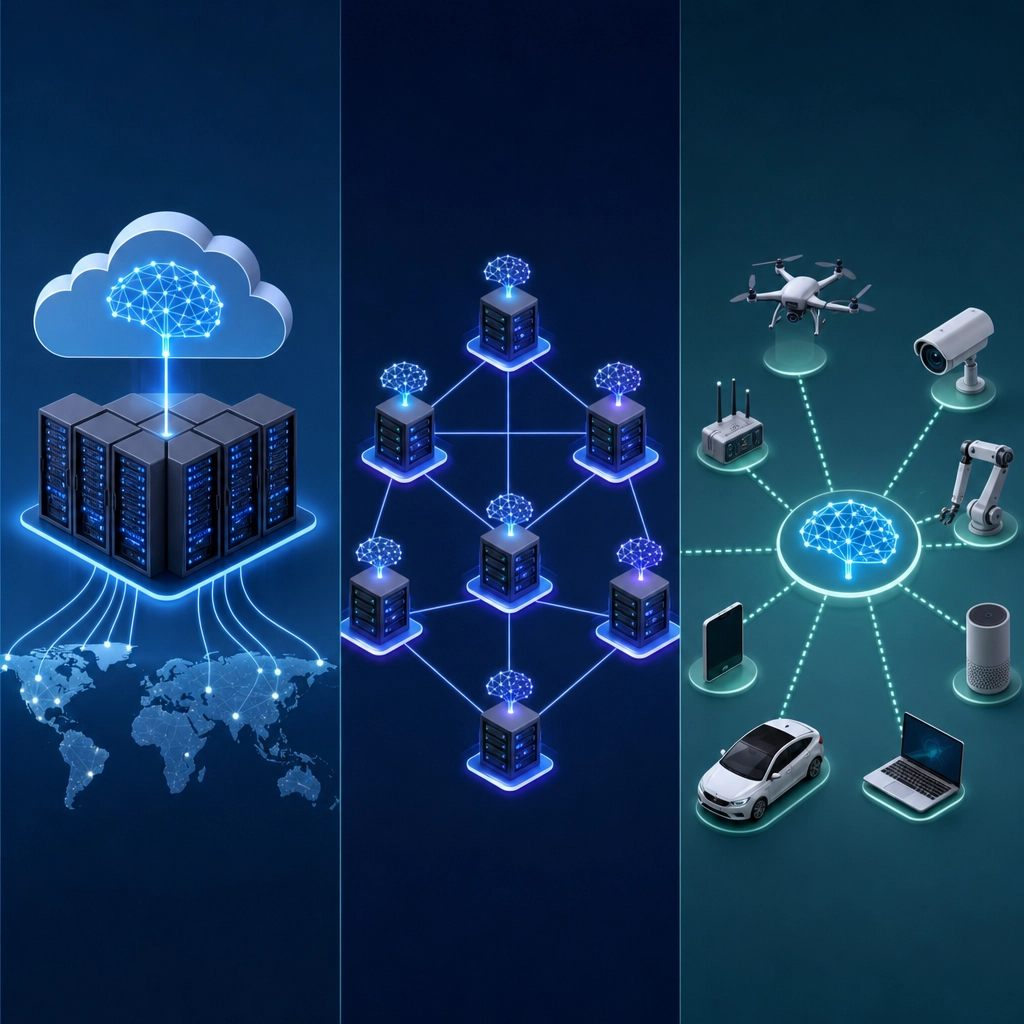
The tech industry has developed a lexicon around AI infrastructure strategies, leading to terms like centralized AI, distributed AI, and edge AI. While these terms may seem distinct initially, their meanings often overlap, and the differences can sometimes blur.
Centralized AI: Single Site, Multiple Nodes
Centralized AI involves hosting AI workloads in a specific location, typically within a single data center or cloud region, utilizing a cluster of servers. Contrary to what the term might suggest, centralized AI doesn’t mean a single machine—large-scale AI workloads, especially those that involve training complex models, usually require multiple servers or GPUs due to their significant computational and memory demands. Although local models operating on a single workstation exist, they are not the norm in enterprise contexts. Essentially, centralized AI centralizes operational resources within one facility, regardless of the distribution of workloads within that space.
Distributed AI: Multiple Sites
Distributed AI spreads AI workloads across several servers and often across multiple sites. This is where confusion can arise, as both centralized and distributed AI can involve multi-node clusters. The primary distinction is geographical and pertains to the number of sites involved. In enterprise settings, distributed AI typically entails deploying across multiple data centers or cloud regions to serve various user groups, enhance resilience, lower latency, or comply with data residency regulations. The key factor here is the intentional multisite footprint.
Edge AI: Proximity to Users and Data
Edge AI places workloads closer to the network edge—near end users, devices, or local data sources—aiming to minimize latency, reduce data transfer costs, or eliminate unnecessary trips to a central data center. Organizations can implement edge AI by establishing compact data centers near users, employing micro data centers for inference, or deploying models directly onto devices. Depending on the architecture, edge strategies can also fit within the distributed AI framework, illustrating the overlap in terminology. While "edge" indicates a location by proximity to users or data, "distributed" refers to a higher-level structural layout involving multiple sites.
Differences Between the Approaches
While the terminology overlaps, focusing on what differentiates these strategies is essential:
-
Site Count and Location: Centralized AI typically utilizes one facility or cloud region, while distributed AI covers multiple facilities, often in different regions. Edge AI may also extend across multiple sites, particularly with micro data centers or on-device deployments.
-
Performance and Cost Objectives: Distributed and edge strategies concentrate on minimized latency and lower data transfer expenses by relocating compute resources closer to users. In contrast, centralized AI emphasizes resource pooling, operational efficiency, and simplicity over geographical considerations.
-
Implementation and Management Complexity: Centralized AI’s singularity simplifies governance and monitoring, while distributed and edge architectures introduce increased complexity around coordination, observability, and data management.
How to Choose the Right Approach
When deciding which model to adopt, it’s critical to align your infrastructure with your organizational goals and constraints. If your operations are based in a single facility and you need a rapid deployment, centralized AI presents a clear option. For organizations serving users across several regions, adhering to data residency laws, or aiming to boost speed and efficiency, a distributed model may be more suitable. When low latency, erratic connectivity, or bandwidth limitations are pressing concerns, edge deployments, including on-device inference, become particularly attractive.
It’s common for enterprises to blend these strategies, using centralized resources for training and distributed or edge resources for inference, all tailored to specific workload requirements.
Welcome to DediRock, your trusted partner in high-performance hosting solutions. At DediRock, we specialize in providing dedicated servers, VPS hosting, and cloud services tailored to meet the unique needs of businesses and individuals alike. Our mission is to deliver reliable, scalable, and secure hosting solutions that empower our clients to achieve their digital goals. With a commitment to exceptional customer support, cutting-edge technology, and robust infrastructure, DediRock stands out as a leader in the hosting industry. Join us and experience the difference that dedicated service and unwavering reliability can make for your online presence. Launch our website.