
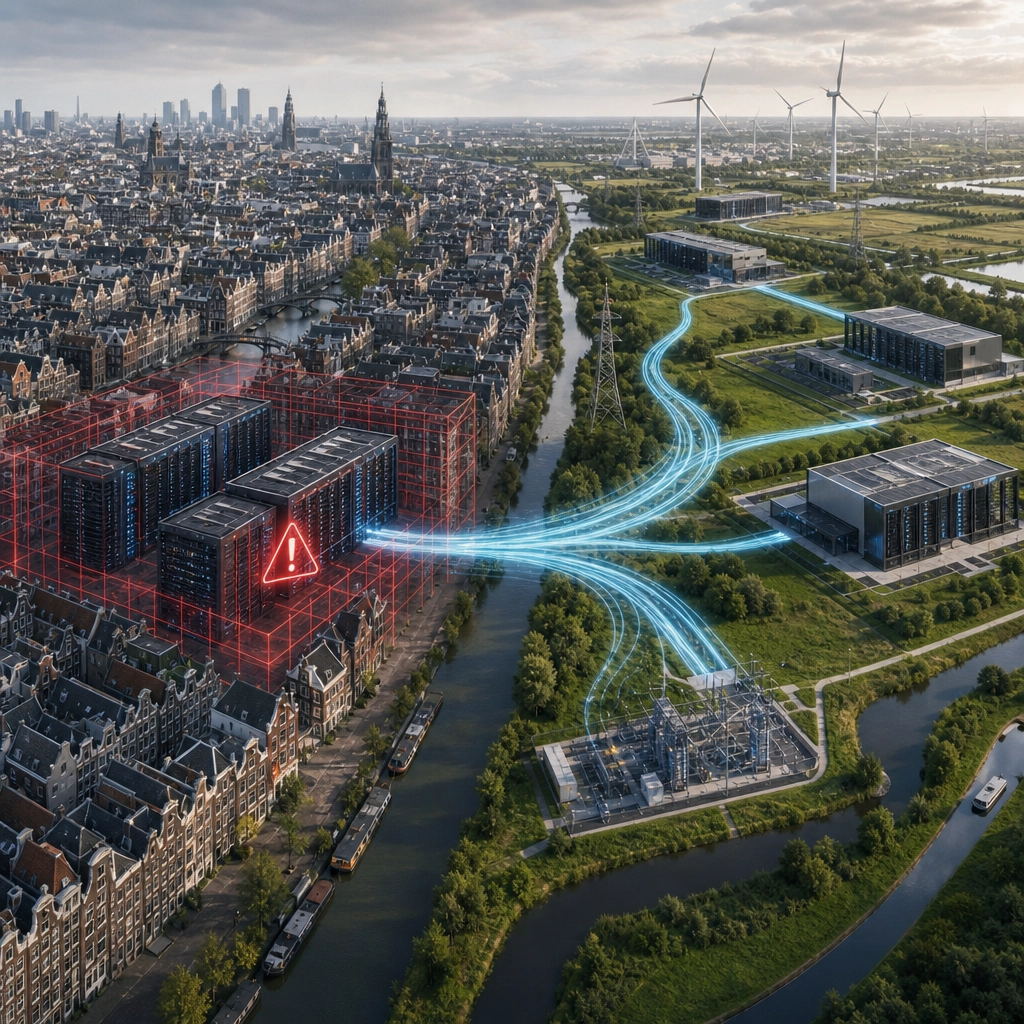
Amsterdam is still a significant player in the European data center market, but rising power constraints are prompting shifts in where new capacities can be built. As of early 2026, Amsterdam ranks as Europe’s fourth-largest data center market, demonstrating an 11% year-on-year increase in inventory, translating to 64.3 MW. However, this growth comes with a tightening vacancy rate at 9.4%, indicating that while demand continues, development faces limitations due to power availability and regulatory obstacles.
In the first half of 2026, Amsterdam saw an addition of 16.3 MW, while Paris significantly outpaced it with 72.5 MW during the same period. This illustrates that while Amsterdam remains attractive due to its connectivity and established market presence, projects are increasingly relocating to other regions where reliable and ample power supply is available.
The geographic landscape for data centers in the Netherlands is becoming more diverse. Though Amsterdam retains its status as the heart of the data center ecosystem, other cities such as Rotterdam, Groningen, and Eindhoven are becoming viable alternatives for new projects.
Amsterdam’s Network Advantage
Amsterdam benefits from its long-established role in the FLAP-D group (Frankfurt, London, Amsterdam, Paris, and Dublin), boasting a robust interconnection network. The Amsterdam Internet Exchange (AMS-IX) processed 35.66 exabytes of traffic in 2025—a fourfold increase since 2015—while connecting 902 parties, which helps maintain close ties for carriers, cloud providers, and content firms.
Luis Fernandes from IDC highlighted the availability of skilled labor and established infrastructure from major colocation companies in the region. The numerous subsea cables that connect to the Netherlands further enhance its position, providing essential low-latency access to key European markets and a growing renewable energy market.
However, with rising demand for data centers, securing a grid connection is not guaranteed. The task now is to balance maintaining Amsterdam’s robust ecosystem while finding locations where sufficient power is available.
Demand for Power Drives Site Selection
In 2026, developers are prioritizing deliverable power above all other site selection criteria, including land costs, incentives, and fiber availability. Assad Noori from JLL emphasized that if developers cannot secure power promptly, other factors become secondary. The demand from AI and other expansive technologies has increased the scale of power requests, leading to longer lead times for installations. Developers are now often required to plan construction years in advance of securing necessary equipment and resources.
The staggering requirements mean that projects must focus on securing reliable power commitments and understanding their timelines before they can break ground. Additionally, with Amsterdam’s land constraints provoking taller data centers, planning must effectively address risks like flooding while optimizing site usage.
Regional hubs such as Rotterdam are gaining traction, leveraging their geographical advantages to combine necessary infrastructure with the ability to build vertically. Rotterdam’s port facilities and strategic location make it a natural candidate for certain workloads, despite facing some of the same challenges as Amsterdam in terms of power and space.
The Future of Market Policy
Recent tightenings in Amsterdam’s regulatory framework, including halting large data center projects, signify an ongoing evolution in urban planning. National policies impose restrictions on hyperscale developments, effectively directing new builds to designated zones specifically allocated for this purpose. While these regulations aim to preserve land and grid capacity, they may complicate long-term investment decisions as rules evolve.
Moreover, aging subsea cable infrastructure poses additional challenges, with the Dutch Subsea Cable Coalition calling for early investments in new intercontinental cables to match future bandwidth demands. To sustain its market advantage, the Netherlands must enhance grid capacity, streamline interconnection processes, promote renewable energy growth, and bolster connectivity while navigating regional development variations.
Overall, as the demand for data centers escalates, a concerted effort from both the industry and regulators is necessary to address these challenges. There needs to be a clear demonstration of value from new projects to local communities and efficient collaboration with municipalities to ensure the continued growth of the data center market in the Netherlands.
Welcome to DediRock, your trusted partner in high-performance hosting solutions. At DediRock, we specialize in providing dedicated servers, VPS hosting, and cloud services tailored to meet the unique needs of businesses and individuals alike. Our mission is to deliver reliable, scalable, and secure hosting solutions that empower our clients to achieve their digital goals. With a commitment to exceptional customer support, cutting-edge technology, and robust infrastructure, DediRock stands out as a leader in the hosting industry. Join us and experience the difference that dedicated service and unwavering reliability can make for your online presence. Launch our website.