
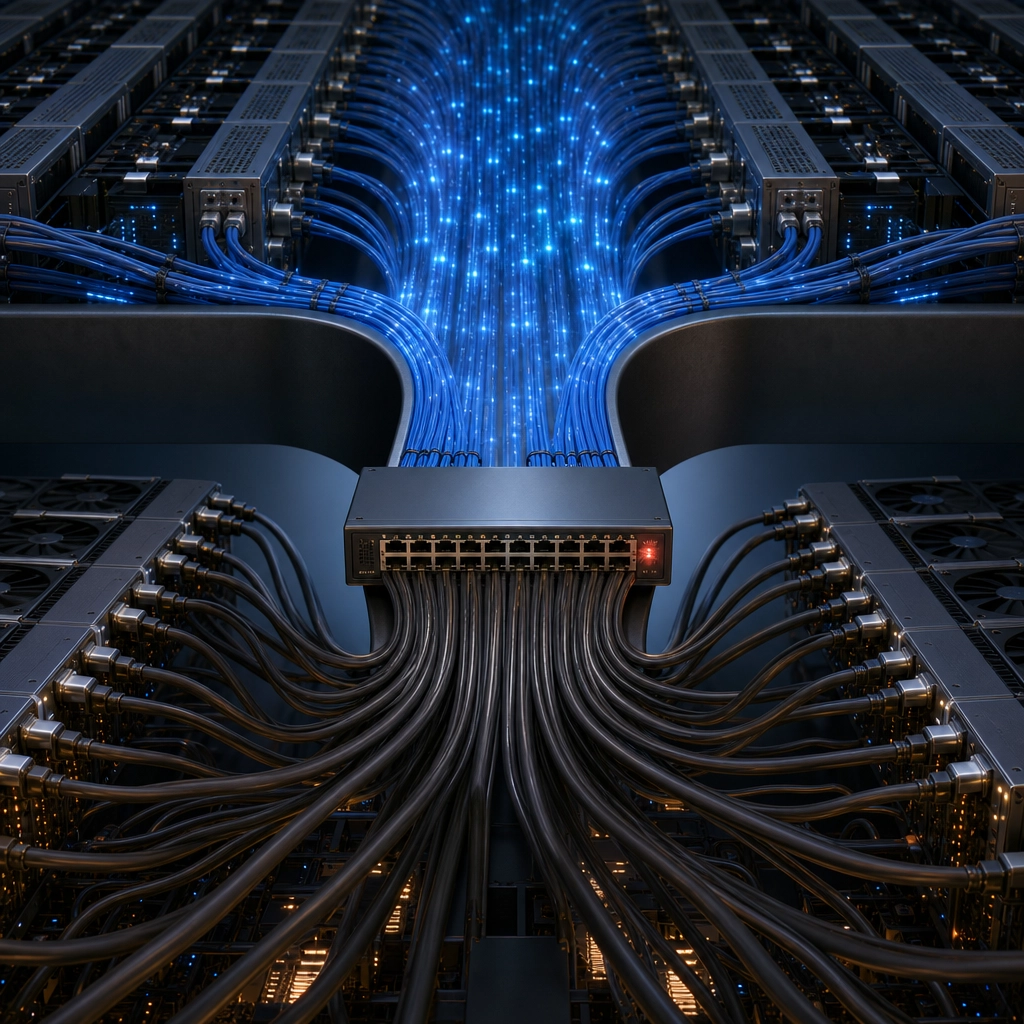
The rapid growth of AI workloads is putting a spotlight on a significant infrastructure challenge: the network. Despite advances in computing power, the network’s ability to keep up is faltering, leading to a scenario where advanced chips remain underutilized, ultimately increasing costs and energy consumption.
Recent studies indicate that AI labs experience a Model Floating Point Operations Per Second (MFU) utilization rate of only 35-40% on Nvidia H100S chips during training of trillion-parameter models. This means that some of the world’s most expensive chips are idling for over half the time as they await data to be transferred via the network.
Currently, the network fabric that connects computing resources serves as the primary constraint on the capabilities of AI systems. The architectural decisions made now will significantly impact the cost, energy efficiency, and competitive potential of future AI infrastructure.
Bandwidth Challenges
AI training workloads are advancing at a staggering pace—from 400 Gb/s to upcoming 1.6 Tb/s line rates—but it’s crucial to note that mere raw link speed doesn’t solve the underlying issues. As clusters expand to include thousands of GPUs, the challenge becomes less about speed and more about how effectively the switching fabric can manage data movement among them.
To remain competitive, network technologies must achieve the 1.6 Tb/s benchmark by 2027; failing to do so could push the ecosystem to seek alternate solutions. This is why networking’s share of data center capital expenditures is projected to rise from roughly 5-10% today to between 15-20% by 2030, marking networking as a key cost driver rather than just an overhead.
Addressing the Bottleneck
The instinctive approach might be to enhance the performance of transceivers, develop denser cabling, and increase line rates. However, such upgrades alone do not tackle the core issue. As interconnect bandwidth grows, it amplifies the stress on each switching node. A switch that might function adequately at 400 Gb/s may become inadequate at 800 Gb/s, essentially revealing the limitations of the switching layer.
Attempting to circumvent this bottleneck by purely enhancing point-to-point interconnections complicates the architecture further, requiring additional laser sources and leading to nonlinear spikes in power consumption and complexity. The switch’s performance must therefore be prioritized to ensure it does not present itself as a bottleneck in the system.
A Disjointed Approach in a Cohesive System
The AI infrastructure has historically developed from a collection of individually optimized components—accelerators, transceivers, interconnects, and switches—each designed to meet its own performance standards. The result is often overengineering and wasted capacity as designers must prepare for the worst-case scenarios at every interface. This results in network fabrics being built for generic workloads that rarely match actual deployments, leading to costly inefficiencies.
Implementing Practical Solutions
To effectively bridge the gap between raw compute and delivered performance, a paradigm shift is required. Rather than piecing together a network fabric from the best available components, AI network architecture should begin with the specific workload and work backward through the design process. This approach entails:
- Co-optimization across the stack: The interposer, interconnect, and switching layer should not be seen as separate entities but rather as interdependent variables that define network performance. Improvements in one area could be nullified by constraints in another.
- Design tailored to specific architectures: Different AI workloads (such as training versus inference) exhibit distinct traffic patterns, latency tolerances, and bandwidth profiles. Effective reference architectures must be crafted for each workload type.
- Reconfigurable photonic packet-level switching: Conventional electronic packet switches face significant limitations as scale increases. Meanwhile, photonic switching presents viable solutions, but the design must be carefully matched to the nature of AI traffic to prevent the kind of idle periods that undermine its potential.
The Road Ahead for Networking
Companies like Nvidia recognize the critical nature of networking, with many investing deeply in the space. The effective return on computational power hinges on whether the network can reliably deliver data at necessary speeds without introducing latency or underutilization.
The future will favor those designing systems from the workload perspective. Adopting architectural solutions that can evolve with the dynamic nature of AI traffic will be crucial for maintaining efficiency and reducing wasted investment in computation. The industry must adapt, or it risks continuing to fund resources that remain critically underused.
Welcome to DediRock, your trusted partner in high-performance hosting solutions. At DediRock, we specialize in providing dedicated servers, VPS hosting, and cloud services tailored to meet the unique needs of businesses and individuals alike. Our mission is to deliver reliable, scalable, and secure hosting solutions that empower our clients to achieve their digital goals. With a commitment to exceptional customer support, cutting-edge technology, and robust infrastructure, DediRock stands out as a leader in the hosting industry. Join us and experience the difference that dedicated service and unwavering reliability can make for your online presence. Launch our website.