
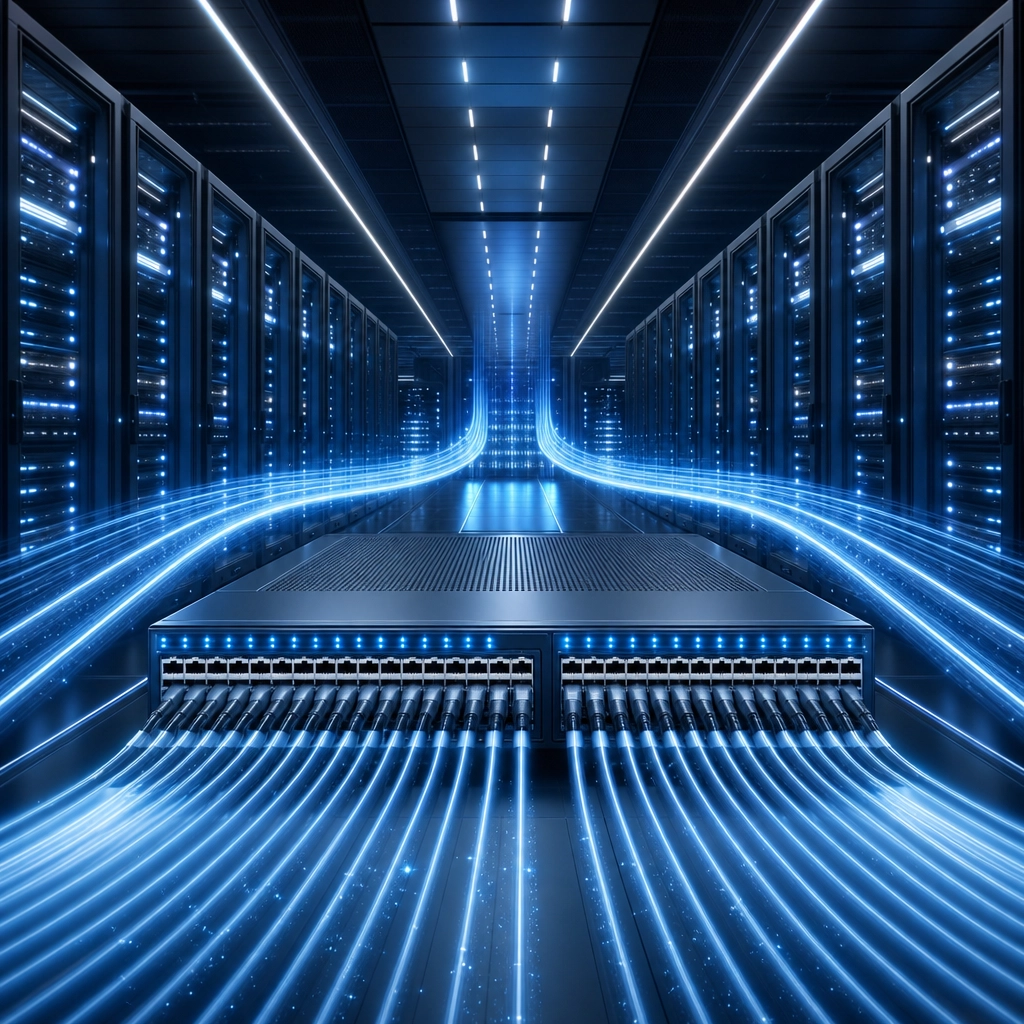
As AI clusters expand, the networking capabilities become a critical factor in performance, particularly with growing demands for bandwidth and low latency. Cisco, Broadcom, and Nvidia are introducing advanced Ethernet switches designed to support these needs, specifically with options for 51.2-102.4 Tbps-class Ethernet switching.
The evolution of AI infrastructure typically proceeds in three dimensions: scaling up involves increasing the computational power per server; scaling out means adding more racks to handle larger models; and scaling across connects data centers via optical networks. Each approach imposes distinct requirements on the network, necessitating high-speed connections and efficient management strategies to optimize performance.
Cisco has detailed its roadmap for AI networking through its new Silicon One chips, such as the G300, aimed at facilitating scale-out within data centers. This chip provides a vast bandwidth capacity—up to 102.4 Tbps—while incorporating mechanisms for congestion avoidance, thereby allowing for uninterrupted GPU performance even during high-traffic bursts.
In terms of scale across multiple data centers, Cisco’s Silicon One P200 addresses the need for high-throughput data transfer over wide-area links. This chip is capable of 51.2 Tbps and includes deep buffering features tailored to minimize latency, which is crucial for maintaining consistent performance across geographically distributed systems.
With AI processing generating significant heat, Cisco’s latest switches also implement liquid cooling systems to efficiently manage thermal loads, ensuring the hardware can sustain prolonged operation under heavy demand.
The market for these advanced switches is expected to start with hyperscalers and AI cloud providers, while enterprise-level adoption may follow as AI workloads become more prevalent. Experts emphasize that companies need to view networking as an integral part of their AI infrastructure, rather than an auxiliary consideration.
Competing technologies from Broadcom and Nvidia are also vying for a share of the AI networking space. Broadcom’s Tomahawk 6 and Nvidia’s Spectrum-6 are both designed to enhance the performance and reliability of AI workloads, incorporating advanced features for optimal data handling.
As data center designs evolve to accommodate denser and more powerful configurations, the development of networking silicon plays a vital role in maximizing the operational efficiency of AI infrastructure.
Welcome to DediRock, your trusted partner in high-performance hosting solutions. At DediRock, we specialize in providing dedicated servers, VPS hosting, and cloud services tailored to meet the unique needs of businesses and individuals alike. Our mission is to deliver reliable, scalable, and secure hosting solutions that empower our clients to achieve their digital goals. With a commitment to exceptional customer support, cutting-edge technology, and robust infrastructure, DediRock stands out as a leader in the hosting industry. Join us and experience the difference that dedicated service and unwavering reliability can make for your online presence. Launch our website.